Helping our customers’ AI speak our language
AI is changing how customers work with service providers. Each assistant brings different context. We're giving them a shared understanding of how Philo Software works.

A customer can arrive at a project meeting with an AI-prepared brief, use an assistant to work through our questions, or turn their feedback into a clear request before we see it. AI is becoming part of the conversation between businesses and their service providers.
For Philo Software, that creates an opportunity to rethink how we work with customers. Their AI can help them participate in a project, gather information, and explain what they need. To do that well, it needs to understand the work we are asking them to do.
Two customers can use the same AI product and still have quite different experiences. One may have detailed instructions about their business. Another may start with a blank chat. Their assistants may have different models, tools, documents, conversation history, and preferences.
Each of those setups shapes the response. An assistant might produce a concise summary, ask a long series of questions, suggest a new solution, or confidently fill in gaps. Those approaches can be useful in the right situation. The challenge is getting the right approach for the task in front of the customer.
A clear request from our team does not necessarily give an AI all the context it needs. It may not know which decisions have already been made, what is included in the project, or what a useful response looks like to the people reviewing it.
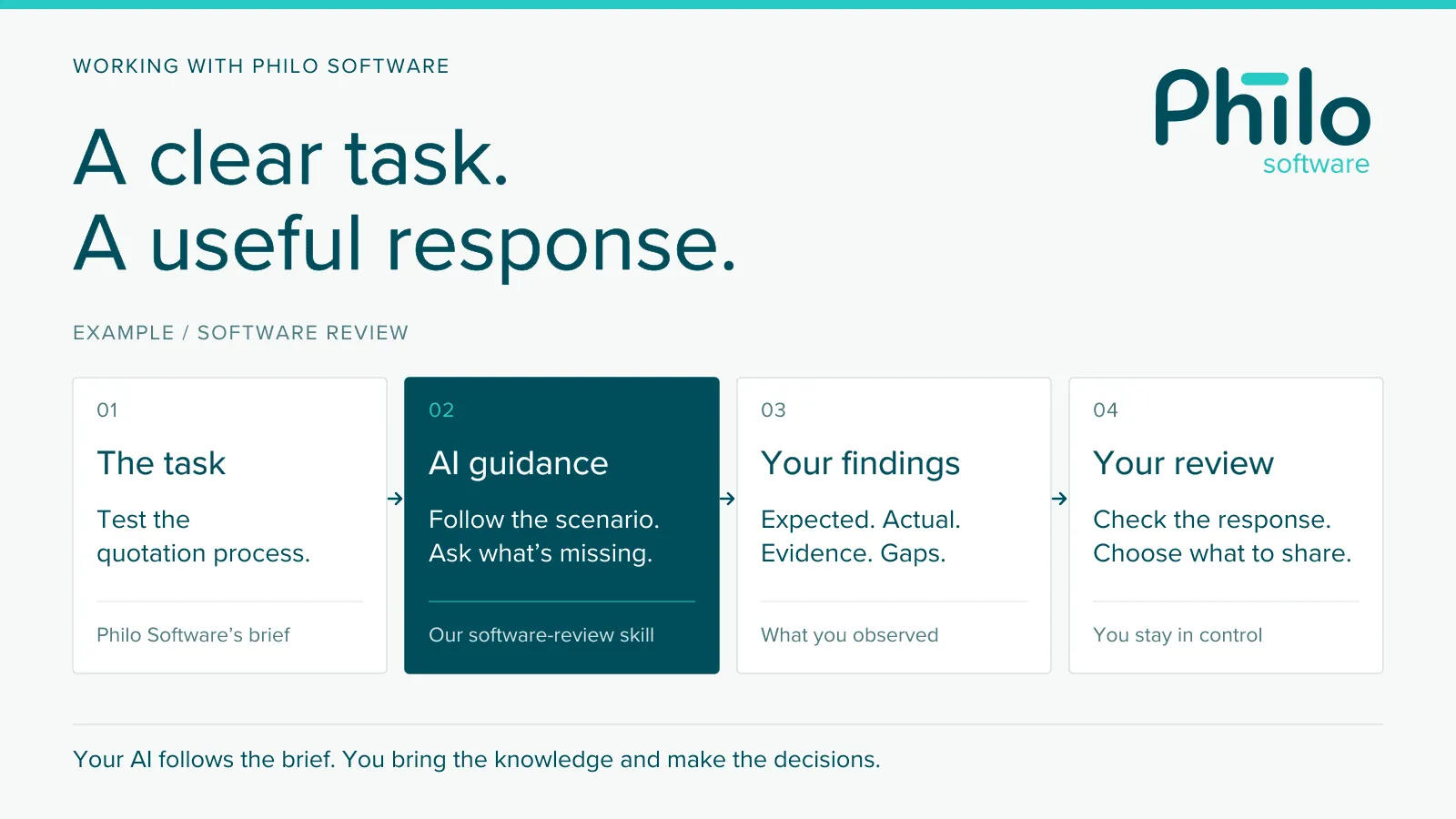
Consider a request to test how a quotation is created in a piece of software. We might need the customer to follow a particular scenario, tell us what happened, and show where the result differed from what they expected.
An AI could turn that into a general review of the quoting process, propose a replacement system, or write a positive summary without the evidence we need. The answer may read well while leaving the original question unresolved.
The same issue appears in the other direction. A customer might say, “We want to make quoting easier.” Their AI can help develop that idea, but our team needs to understand the current process, who is affected, the practical problem, and the outcome the customer wants.
This is a context challenge for everyone involved. We need to make our requests clear, and give the customer's AI enough guidance to help them respond. Customers should be able to use the assistant they are comfortable with, without having to teach it our entire way of working.
That thinking led us to create Philo Software's AI add-on for ChatGPT and Claude. It brings our processes, guidance, and best practices into the customer's own AI through a collection of reusable skills.
A skill is a guide for a particular kind of work. It sets out what the task is trying to achieve, the steps to follow, and what information makes a useful result. The AI can draw on the relevant guidance when helping the customer.
Our skills cover finding assigned work, answering project questions, reviewing software, preparing website work, and checking what needs attention. They help the AI work through the brief, recognise missing information, and keep new ideas separate from the work already agreed.
When we ask for something, the customer's AI has guidance for understanding what is needed and helping them prepare a response. When the customer wants something from us, their AI can help organise the context, examples, and desired outcome into a clearer request.
From day one, the AI has a head start on speaking our language. That gives us a common starting point for the conversation and can reduce repeated explanations and avoidable back and forth.
Installing the add-on does not send Philo Software the customer's conversations or business information. It gives their AI guidance about working with us.
Customers decide what they want to share. Where they choose to connect their project access and use the guided reporting workflow, task updates are shared with their agreement and final responses are shown for review before submission.
The customer's knowledge and judgement still matter. An AI should help identify a gap rather than invent an answer, preserve concerns rather than smooth them away, and help raise a new idea without treating it as an approved change to the project.
Our team remains responsible for reviewing the work, clarifying requirements, and agreeing the next step with the customer.
As businesses bring AI into more of their work, the way they interact with service providers will evolve too. Service providers have a role in making their processes understandable to the assistants their customers choose to use.
For Philo Software, the add-on is a practical step in that direction. It gives customers an AI that is better prepared to guide them through our processes, while keeping the relationship with our team at the centre of the work.
AI is optional. Customers can continue working with us through conversations, email, and direct collaboration. If they want to learn how to use AI, we can help them get started.
Explore a new way to work with Philo Software and find out how to give your AI our working guidance.
Have something in mind?
Thinking out loud
AI is changing how customers work with service providers. Each assistant brings different context. We're giving them a shared understanding of how Philo Software works.
Every customer conversation and project decision adds to what your business knows. But when that understanding stays inside individual AI tools, the rest of the business misses out. The lasting value is in building company knowledge you own—kept centrally, growing with every project, and available to the people and tools doing the work.